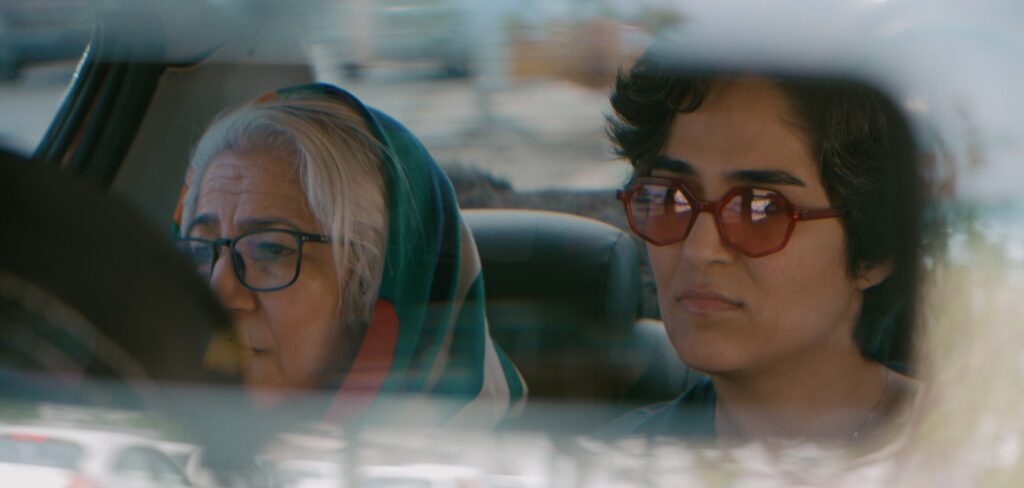
How do you show a household to an audience? A realtor will bake cookies and rearrange the furniture. A party host will put up decorations and play some music. But a documentarian will show you the family and how they live in and share that space with each other. And when Elahe Esmaili shows her own home she does just that.
The ways in which our homes follow us beyond our dwelling can go forgotten. How parents still want their children to fallow the rules of their home sometimes long after they have already moved out. Esmaili clearly loves her parents deeply. And it is obvious throughout their time on screen that they love her just as much. The fundamental conflict that permeates throughout the documentary is less of a conflict of interests and rather a conflict out of concern. It is her mother’s concern for her seftey in public and how what others might think of her that primarily drives her to keep pushing for her daughter to cover her head. And this is what makes the way Esmaili shows us her home so effective and immersive. The emotions that are allowed to be shown between a parents and their child. When she goes to comfort her teary eyed mother, the camera does not stop. It is not reported on later by her. She allows the audience into the moments that happen in almost every home. Moments of vulnerability and raw emotion that most of us only feel comfortable having in our homes.
There is also a sense of poetic irony to the timing of her documentary. The time when you are packing up your house to relocate your home is a time when, even for a brief moment, we feel like we lose that protection and comfort. While Esmaili helps her parents change their home in a physical way, she also documents the way a home can change through the people in it. And even if those changes happen moment by moment, box by box, hat by hat, change will come.